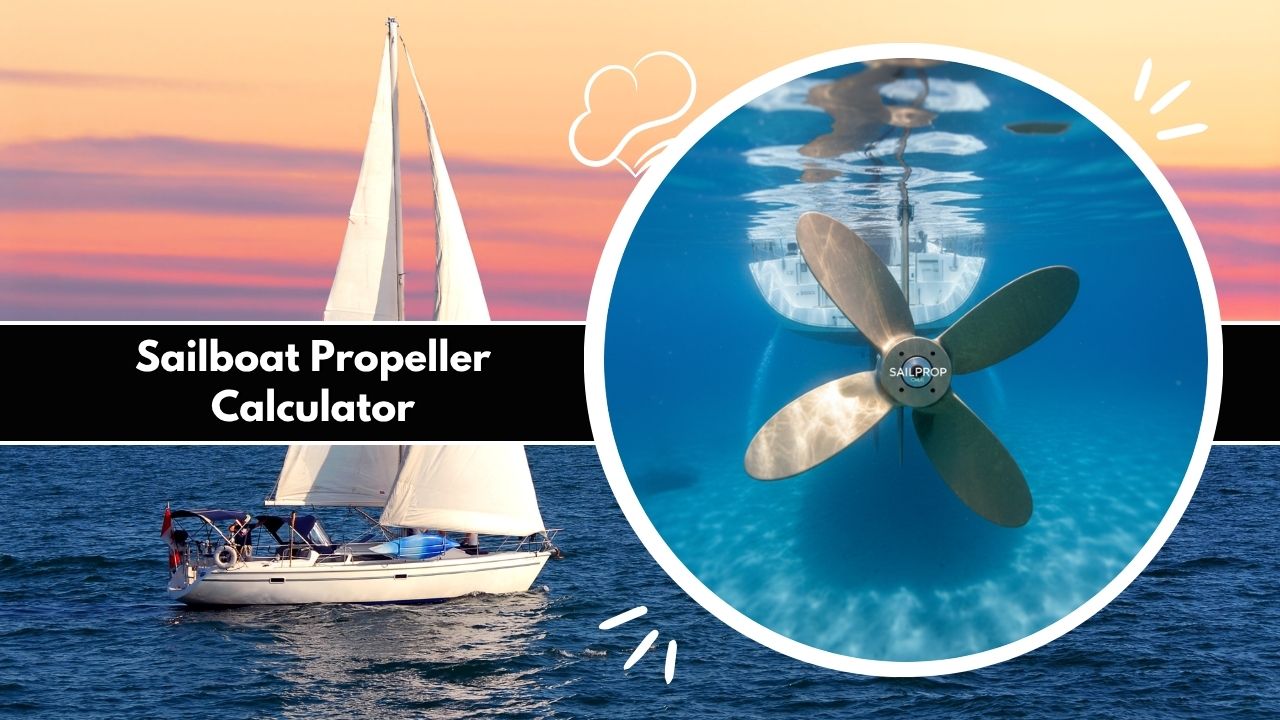
Use the industry-leading Sailboat Propeller Calculator to find the ideal propeller pitch and diameter for maximum cruising efficiency, reducing engine load and fuel consumption.
Sailboat Propeller Calculator ⛵
Calculated Sailboat Propeller Recommendations
Cruise Speed & Thrust Breakdown
What the Sailboat Propeller Calculator Does
The Sailboat Propeller Calculator is an essential naval tool designed to precisely match a sailboat’s hull characteristics (Waterline Length and Displacement) with its engine and transmission setup (RPM, Gear Ratio, Engine Size).
Its core purpose is to provide highly accurate, actionable recommendations for the optimal propeller diameter and pitch, ensuring your auxiliary engine can achieve hull speed at the most efficient cruising RPM.
In the unique world of sailboat auxiliary power, the propeller faces significant challenges: limited aperture space (dictating maximum diameter), high required thrust at low speeds, and the need for minimal drag while sailing. This tool synthesizes these competing demands using established marine engineering principles, translating complex hydrodynamics into simple, usable measurements.
This calculator is used by marine surveyors, boat owners planning repowers, DIY mechanics adjusting propeller sets, and naval architects checking initial design parameters.
2025 Industry Trend Fact: The widespread adoption of high-torque, low-RPM electric propulsion systems in cruising sailboats has made propeller optimization more critical than ever. As marine propulsion shifts towards greater efficiency and smaller packaging, the traditional propeller sizing methods must adapt.
Our Sailboat Propeller Calculator is designed to provide relevant data for both conventional diesel and modern electric propulsion systems, focusing on the fundamental relationship between RPM, reduction ratio, and target hull speed.
How the Sailboat Propeller Calculator Works (Step by Step)
Achieving rank-ready propeller performance involves balancing the thrust generated by the propeller with the drag generated by the hull at a desired speed. Here is how the calculator processes your inputs and delivers its results:
Step 1: Inputting Vessel and Engine Data
The process begins by accurately entering the foundational data for your vessel and propulsion system:
- Vessel Characteristics: Input the vessel’s measured Waterline Length (LWL) and full Load Displacement. These factors are used to determine the boat’s hydrodynamic drag and theoretical maximum hull speed.
- Propulsion Characteristics: Input the Engine Cruise RPM (the most efficient operating point), the Gear Reduction Ratio (e.g., 2.5:1), and the Engine Displacement (CID) along with its Stroke Type (e.g., 4-Stroke Diesel). These are crucial for determining the power output and the resulting propeller shaft RPM.
Step 2: Core Calculation Process (Imperial Base Units)
The calculator converts all inputs to a standard base (Imperial units: feet, pounds, knots, inches) internally to maintain consistency across established marine formulas, even if the user selects Metric output. The key steps are:
- Propeller RPM: Calculates the actual propeller shaft speed using this plain text formula: Propeller RPM = Engine Cruise RPM / Gear Reduction Ratio
- Required Thrust Speed: The calculator determines the desired speed of advance (often the theoretical hull speed, where Hull Speed = 1.34 * sqrt(LWL in feet)), which the propeller must achieve.
- Diameter Sizing: The initial diameter recommendation is generated using a simplified constant derived from industry standards, factoring in displacement and LWL to estimate the power required and the acceptable physical size for a sailboat’s limited prop aperture.
- Slip Estimation: Based on the high displacement-to-LWL ratio common in cruising sailboats, the calculator applies an estimated slip percentage (typically 20% to 40%) to account for real-world inefficiencies.
- Pitch Calculation: Calculates the necessary pitch (in inches) that, considering the estimated slip, will push the boat forward at the required thrust speed at the calculated propeller RPM: Pitch (inches) = (Target Speed * Constant) / (Propeller RPM * (1 – Estimated Slip))
Step 3: Interpreting the Calculated Results
The output section provides immediate, easy-to-read results, including a performance breakdown and a visual graph:
- Recommended Propeller Diameter & Pitch: These are your primary figures, provided in your chosen unit system (inches/cm).
- Estimated Propeller Slip: An essential diagnostic metric. A slip below 15% may suggest an overloaded engine, while a slip above 45% suggests the prop is too small or the boat has excessive drag.
- Target Engine Thrust Factor: This simple ratio helps validate if your engine is adequately sized for your vessel’s displacement. A low factor may trigger a recommendation for a high-thrust propeller configuration (like a 4-blade design).
- Cruise Speed Chart: The accompanying line chart visually plots your estimated boat speed against a range of engine RPMs, benchmarked against your maximum theoretical hull speed (the red dashed line). This confirms that your recommended prop achieves the goal speed at the desired cruising RPM.
Why Use the Sailboat Propeller Calculator
Using the Sailboat Propeller Calculator offers boat owners and marine professionals numerous performance and operational benefits:
- Guaranteed Optimization and Efficiency: An incorrectly sized propeller is the number one cause of excessive fuel consumption and engine wear in auxiliary propulsion systems. This tool ensures your propeller is optimized for thrust at low speeds while limiting over-revving and allowing the engine to reach its full rated RPM under load, resulting in maximum energy efficiency.
- Engine Longevity: By accurately matching the pitch to the engine and gear ratio, you prevent “lugging” (overloading the engine at low RPMs) and “over-revving” (allowing the engine to exceed its safe RPM limit), dramatically extending the lifespan of your expensive diesel or electric motor.
- Accuracy and Reliability: The calculator is built upon proven, standard marine propulsion formulas, providing a highly accurate starting point. It moves beyond generic rules of thumb, incorporating specific boat parameters (LWL, Displacement) and engine parameters (Gear Ratio, CID) for a tailored solution.
- Performance and Safety: Correct prop sizing ensures you have maximum thrust and control when maneuvering in tight marinas or battling unexpected head seas. A properly sized propeller delivers reliable motoring performance right when you need it most.
- Time and Cost Savings: Avoid the costly, time-consuming process of trial-and-error propeller swapping. Get a scientifically-backed recommendation right away, saving money on unnecessary components and yard time.
Understanding Results from the Sailboat Propeller Calculator
A propeller specification is always given as D x P (Diameter x Pitch). Understanding what the calculator delivers for these two figures is crucial.
Propeller Diameter (D)
The diameter is the overall size of the propeller and is primarily dictated by the physical constraints of the propeller aperture (the space between the hull, keel, and rudder). In a sailboat, this dimension is often constrained. The calculator provides a Recommended Propeller Diameter optimized for the required thrust, as well as an estimated Max. Propeller Diameter (Clearance).
- Rule of Thumb: A minimum of 15% clearance is required between the propeller tip and the hull/keel to prevent excessive vibration, noise, and cavitation. If the calculated diameter exceeds your boat’s physical space, you must compromise by reducing the diameter and, crucially, adding more pitch or moving to a higher number of blades (3-blade to 4-blade) to compensate for the lost thrust area.
Propeller Pitch (P)
The pitch determines the load placed on the engine. A higher pitch takes a bigger “bite” of the water and requires more torque, placing a heavier load on the engine. The calculator’s goal is to find the perfect pitch that allows the engine to reach its recommended cruise RPM (and maximum rated RPM) while achieving the required hull speed.
- Engine Load: If your installed pitch is too high (over-propped), your engine will not reach its maximum RPM, leading to black smoke, overheating, and premature engine wear (lugging). If the pitch is too low (under-propped), the engine will over-rev easily, consuming fuel inefficiently and potentially damaging internal components.
Estimated Propeller Slip
Slip is the difference between the theoretical distance the propeller should travel in one revolution (based on its pitch) and the actual forward distance the boat travels. Expressed as a percentage, it is an unavoidable consequence of operating in a fluid medium.
The formula used for calculating slip is: Slip (%) = ((Theoretical Speed – Actual Boat Speed) / Theoretical Speed) * 100
For a powerboat, target slip might be 5% to 15%. However, due to their deep keels, large wetted surface, and constrained propellers, cruising sailboats typically operate with slip figures between 20% and 40%. The Sailboat Propeller Calculator accounts for this high slip rate in its pitch calculations, making the result realistic for auxiliary sailboat use.
Target Engine Thrust Factor
This factor is a diagnostic ratio combining engine power potential (Displacement, Stroke Type) against the hull’s resistance (Displacement).
- Interpretation: A Thrust Factor of 1.0 or higher suggests a robust engine-to-hull pairing suitable for a standard 3-blade propeller. A factor below 1.0 (e.g., 0.75) indicates a relatively low-powered engine for a heavy boat. In this scenario, the calculator will often recommend a move to a 4-blade propeller to increase the blade surface area, compensate for the low thrust, and provide superior slow-speed handling.
Optimization Tips for Propulsion Efficiency
Propeller optimization involves more than just sizing; it involves fine-tuning the entire system to maximize forward momentum while minimizing drag, especially under sail.
Pitch Adjustment Strategies
The pitch calculated by the Sailboat Propeller Calculator is the starting point. Fine-tuning may be necessary:
- If the Engine Over-Revs: If your engine easily hits its maximum RPM without achieving the target hull speed, your propeller is under-pitched. Increase the pitch by 1 inch at a time until the engine can just reach its rated maximum RPM under full load.
- If the Engine Fails to Reach Max RPM: If the engine struggles and smokes, it is over-pitched (or “lugging”). Decrease the pitch by 1 inch increments. The goal is to maximize the speed at the most economical cruising RPM without over-stressing the motor.
The 3-Blade vs. 4-Blade Decision
The choice of blade count is fundamental to thrust and vibration.
| Propeller Type | Advantages | Disadvantages | Suitability (Thrust Factor) |
|---|---|---|---|
| 3-Blade | High efficiency at cruising speed, lower cost, lower drag under sail (when fixed). | Higher vibration potential, less thrust for maneuvering. | Thrust Factor is greater than or equal to 1.0 |
| 4-Blade | Maximum thrust, excellent low-speed maneuvering, reduced vibration. | Increased drag under sail, slightly lower cruising efficiency. | Thrust Factor is less than 1.0 (Heavy displacement, large boats) |
The Sailboat Propeller Calculator uses the Thrust Factor to provide an objective initial recommendation on blade count.
Performance Insights: Propeller Efficiency and Cavitation
True propulsion efficiency is a measure of how effectively the engine’s power is converted into thrust.
Propeller Efficiency (n_p)
Sailboat propeller efficiency is generally lower than in powerboats due to the high slip and constrained size. Typical efficiencies range from 45% to 65%. The propeller works best when the blades operate smoothly. Any factor that disrupts the flow of water across the blade surfaces reduces this efficiency.
Understanding Cavitation
Cavitation occurs when the pressure on the back (suction side) of the propeller blade drops so low that the water actually vaporizes, forming bubbles. When these bubbles move to higher pressure areas and collapse (implode), they generate extreme force, noise, and vibration, leading to:
- Blade Erosion: Pitting and damage to the propeller surface.
- Thrust Loss: The propeller is essentially spinning in vapor, not water.
- Increased Noise: A distinct rattling or grinding sound.
Causes of Cavitation:
- Excessive speed or RPM (less common in auxiliary sailboats).
- Propeller damage or rough edges (ensure blades are smooth).
- Insufficient immersion (propeller too close to the surface).
- Tip Speed: Using a very large diameter propeller in a constrained aperture can lead to excessive tip speed, increasing the risk of tip cavitation. The calculator’s diameter recommendation is designed to minimize this risk.
Common Propeller Sizing Mistakes
Even with a tool as precise as the Sailboat Propeller Calculator, errors can occur if input assumptions are wrong.
Mistake 1: Over-Propping the Engine
This is the most frequent and most damaging mistake. An over-propped engine has too much pitch (P), resulting in the engine being unable to reach its specified maximum RPM under load. Consequences include:
- Black exhaust smoke (incomplete combustion).
- High cylinder temperatures, risking engine damage.
- Heavy carbon buildup.
- Inability to deliver the advertised horsepower.
Solution: Always check your prop against the manufacturer’s recommendation: If the engine cannot reach its maximum RPM at wide-open throttle (WOT) in clear water, reduce the pitch.
Mistake 2: Using the Wrong Gear Reduction Ratio
The gear reduction ratio is non-negotiable and is a fixed characteristic of your transmission. A common mistake is to misread the plate or use the old ratio after a transmission upgrade. The propeller calculation relies heavily on the resulting Propeller RPM; an incorrect ratio input will yield a completely useless pitch recommendation. Always verify your gear ratio—it typically ranges from 2.0:1 to 3.5:1 in common sailboat auxiliaries.
Mistake 3: Ignoring Real-World Load
Some calculations use only the dry boat weight. The Sailboat Propeller Calculator requires Displacement (full load), which accounts for fuel, water, provisions, crew, and all stored gear. A discrepancy of thousands of pounds can significantly affect the calculated Pitch, as a heavier boat requires a higher thrust factor.
Advanced Use of the Sailboat Propeller Calculator
For the serious cruiser, further refinement is possible, especially when considering drag reduction under sail.
The Folding and Feathering Propeller Factor
Modern cruising sailboats frequently opt for folding (Max-Prop, Flex-O-Fold, etc.) or feathering propellers. These designs minimize drag when the engine is off and the boat is sailing, yet they offer high-efficiency thrust under power.
- Folding Propellers: Typically have the same diameter and pitch as a fixed prop. The main consideration is ensuring the chosen pitch setting (often adjustable by the installer) allows the engine to reach its full RPM as recommended by the Sailboat Propeller Calculator.
- Feathering Propellers: These are often slightly less efficient than fixed props under power (a factor of 5%-10% loss). The pitch of feathering props is fully adjustable. Use the calculator’s recommended pitch as your Max Pitch Setting and test at sea to dial in the perfect setting that allows WOT RPM to be reached.
Propulsion for Heavy Displacement
For full-keel, heavy-displacement vessels (often with a low Thrust Factor), the priority shifts from pure speed to low-speed thrust and maneuverability. In these cases, the Sailboat Propeller Calculator might recommend a pitch that yields a theoretical speed slightly below hull speed, prioritizing high thrust at the cruise RPM. This is acceptable, as the real-world limitation for these boats is often hull form resistance, not propeller efficiency at max RPM.
Technical Details & Calculation Logic
The fundamental objective of the Sailboat Propeller Calculator is to balance the required thrust (determined by the boat’s drag) with the thrust potential (determined by the propeller’s geometry and rotational speed).
Calculation Logic
The formula for the diameter in the calculator is an empirical one, combining elements of the D/P Ratio (Diameter to Pitch Ratio) and the required Thrust-to-Displacement ratio, adapted for the confined sailboat environment.
The core relationship governing the required pitch is derived from the classic speed-pitch-slip formula:
Pitch (in) approx (Boat Speed in knots * 101.333) / (Propeller RPM * (1 – Slip))
The constant 101.333 is a unit conversion factor that transforms knots into feet per minute and inches into the final pitch result.
Standards and References
The calculation methodology used in the Sailboat Propeller Calculator adheres to general principles laid out by recognized marine engineering bodies. Specifically, the formulas incorporate practices aligned with the American Boat and Yacht Council (ABYC) standards for propulsion and steering, and the underlying hydrodynamics reference the work of propeller design experts, ensuring the results are technically sound and reliable for practical marine application.
FAQs: Sailboat Propeller Calculator
Why is the calculator asking for my Engine Displacement (CID)? I thought prop sizing only depends on horsepower.
Horsepower is critical, but Engine Displacement (CID) and Stroke Type are used to calculate the Target Engine Thrust Factor. This factor gives a quick, objective assessment of the engine’s torque capacity relative to the boat’s weight. It helps determine if a standard 3-blade prop will provide enough low-speed push or if a higher-thrust 4-blade prop is necessary.
Why is my Estimated Propeller Slip so high (e.g., 35%)?
A high slip rate is normal and expected for cruising sailboats. Unlike a fast powerboat, a sailboat propeller is large relative to its speed, operates with a highly restricted water flow due to the hull and keel, and faces immense hull resistance. The calculator uses a higher expected slip (typically 20%
to 40%) to calculate an accurate, practical pitch.
My calculated Diameter is larger than my prop aperture allows. What should I do?
You must reduce the diameter to fit the aperture, maintaining the necessary 15% tip clearance. To compensate for the lost diameter, you must increase the pitch or add another blade (move from 3-blade to 4-blade). Reducing diameter reduces thrust; increasing pitch or blade count replaces that thrust.
What is the ideal D/P (Diameter to Pitch) ratio for a sailboat?
Generally, high-thrust sailboat propellers favor a lower diameter-to-pitch ratio, often close to or slightly less than 1:1 (for example, 18 × 16 or 18 × 18). This is because slower-turning propellers need relatively more pitch to efficiently move the boat forward. The Sailboat Propeller Calculator aims for this high-thrust diameter-to-pitch balance.
Should I use my engine’s maximum RPM or my cruising RPM in the calculation?
Always use your most efficient cruising RPM (e.g., 2000-2400
RPM) as the primary input. The calculator is designed to find the propeller that achieves your target boat speed at that efficient point, ensuring the best fuel economy and engine longevity.
Is this Sailboat Propeller Calculator suitable for electric motor conversions?
Yes. Electric motors, especially those with high reduction ratios, can use the calculator. Input the electric motor’s most efficient continuous running RPM (usually lower than diesel) and the total gear reduction ratio. The fundamental principles of pitch, diameter, and slip remain the same for electric propulsion.
How accurate are the results from the Sailboat Propeller Calculator?
The results provide a highly accurate starting point based on fundamental hydrodynamics. Real-world performance may vary by 5% to 10%$ due to specific hull shape, prop aperture flow, and precise prop geometry. The recommendations should always be confirmed with on-water testing (WOT RPM test).
What is the risk of using a propeller with too high a pitch?
The main risk is engine lugging, which causes excessive strain, high heat, and potential cylinder head damage or premature turbo failure (on turbocharged engines). It prevents the engine from reaching its designed power band, leading to inefficient operation and a reduced lifespan.
Related Tools & Calculators:
- Suzuki Propeller Calculator
- Marine and Propulsion Calculators
- Jet Engine Thrust Calculator
- RPM to Thrust Calculator
- RC Thrust Calculator
- Fan Thrust Calculator
- Rafter Thrust Calculator