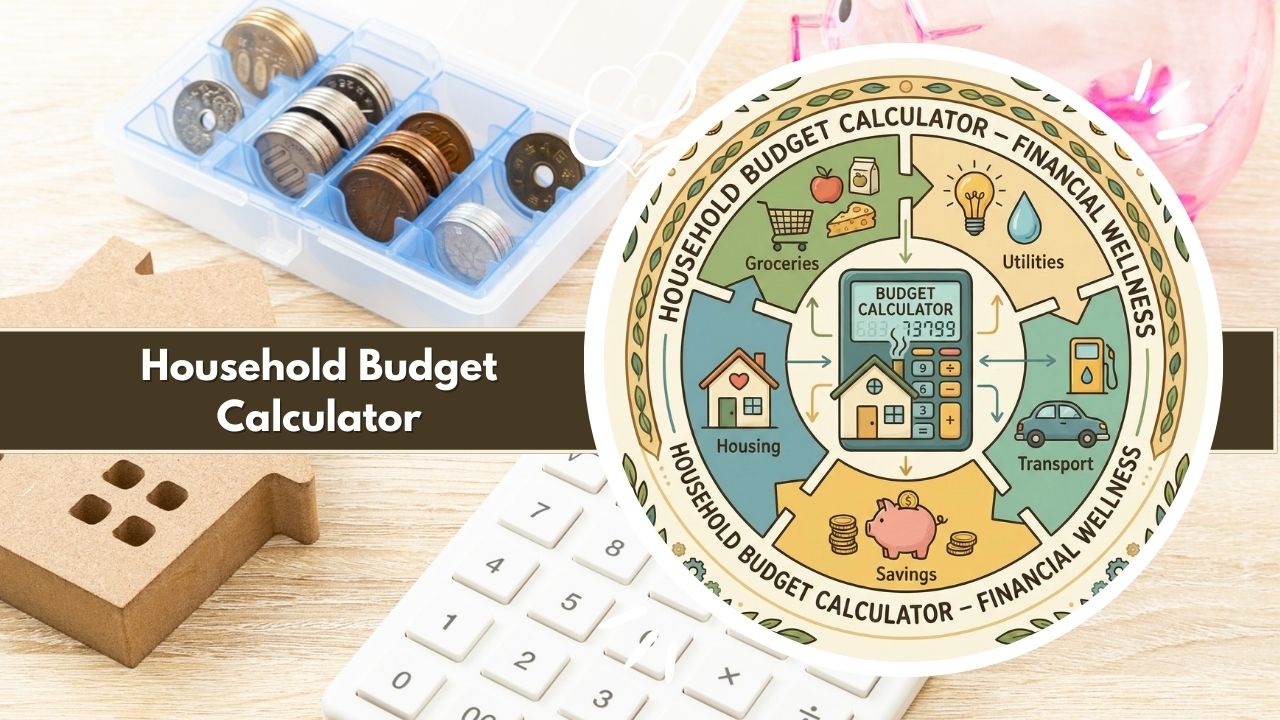
Track monthly income and expenses with our free Household Budget Calculator. Instant budget calculation for US, Canada & UK households to manage savings.
Expense Breakdown
In an era of fluctuating economies and rising living costs, gaining clarity on your finances is no longer just a good habit—it is a necessity. The Household Budget Calculator is designed to provide that clarity instantly. Whether you are managing a bustling family home, coordinating finances as a couple, or navigating student life, understanding the exact relationship between your monthly income and your expenses is the foundation of financial health.
Rising inflation has made it increasingly difficult for many households to track where their money goes. A few small subscriptions here and an extra grocery run there can quickly tip the scales from surplus to deficit. This tool acts as a powerful, real-time financial mirror. It instantly calculates your Total Income, sums up your Total Expenses, and derives your Remaining Balance with precision.
Designed for versatility, this Monthly Household Budget Calculator works seamlessly for users in the US, Canada, the UK, and beyond. It eliminates the guesswork, helping you answer the most critical question in personal finance: “Do I have money left over at the end of the month?” By moving beyond mental math and into concrete data, you can stop surviving month-to-month and start planning for the future with confidence.
How the Household Budget Calculator Works
The core strength of this Free Household Budget Calculator lies in its simplicity and its robust calculation engine. Unlike complex financial software that requires bank linkage or invasive permissions, this tool works on a transparent, logic-based formula that updates in real-time.
The calculator operates on a fundamental accounting principle: Remaining Balance = (Total Income – Total Expenses)
The Input Process
To get an accurate picture of your financial health, the calculator breaks down your finances into two distinct sections:
- Income Section: Here, you input all streams of revenue. This isn’t limited to just your 9-to-5 paycheck. You can include your Net Salary (after tax), income from side hustles, freelance work, bonuses, and investment returns. Capturing every dollar coming in is crucial for an accurate baseline.
- Expenses Section: This is where the Household Budget Calculator shines by categorizing spending into six key pillars:
- Housing: Rent or mortgage payments plus essential utilities.
- Food: Groceries and dining out costs.
- Transportation: Fuel, car payments, insurance, and public transit fees.
- Debt: Student loans, credit card minimums, and personal loans.
- Savings: Contributions to emergency funds or retirement accounts.
- Entertainment/Misc: Subscriptions, hobbies, and discretionary shopping.
The Calculation Engine
Once you input these figures and click “Calculate,” the engine instantly processes the data. It aggregates your income sources into a Total Monthly Income and sums your spending into Total Monthly Expenses. It then subtracts expenses from income to reveal your Remaining Balance.
Beyond the raw numbers, the tool visualizes your data. You receive a percentage breakdown of your expenses, showing you exactly how much of your budget is consumed by housing versus debt or food. This immediate feedback loop allows you to adjust inputs—perhaps reducing “Entertainment” to see how it affects your “Savings”—simulating financial decisions before you make them in real life.
Inputs & Outputs
To maximize the utility of this Household Budget Calculator Template, familiarity with the data points is helpful. The tool is designed to be comprehensive yet user-friendly.
Inputs You Can Enter
Income Sources:
- Net Salary: Your primary take-home pay.
- Side Hustles: Uber, DoorDash, or consulting fees.
- Freelance Work: Irregular contract income.
- Bonuses: Quarterly or annual performance pay (averaged monthly).
- Passive Income: Rental property or dividends.
Expense Categories:
- Housing: The roof over your head and the lights keeping it bright.
- Food: Essential nutrition and social dining.
- Transportation: The cost of getting from point A to point B.
- Debt: Repayment of borrowed funds.
- Savings: “Paying yourself first.”
- Entertainment & Misc: Lifestyle choices and non-essentials.
Outputs You Get
Upon calculation, the tool delivers a complete financial snapshot:
- Total Monthly Income: A clear sum of all revenue.
- Total Monthly Expenses: The aggregate cost of your lifestyle.
- Remaining Balance: Your “bottom line”—positive means surplus, negative means deficit.
- Savings Percentage: Understanding what slice of the pie goes to your future.
- Expense Breakdown Chart: A visual graph highlighting spending hotspots.
- Downloadable CSV: A Household Budget Calculator Excel compatible file for offline tracking.
Example – Monthly Household Budget Breakdown
To illustrate the power of this Household expense calculator, let’s look at a realistic scenario for a dual-income household living in a mid-sized city.
The Scenario
Income:
- Net Salary (Combined): $4,200
- Freelance/Side Hustle Income: $400
- Quarterly Bonus (Averaged): $200
- Total Monthly Income: $4,800
Expenses:
- Housing (Rent + Utilities): $1,400 (roughly 29% of income)
- Food (Groceries + Dining): $650
- Transportation (Car loan + Gas): $320
- Debt (Student Loans + Credit Card): $300
- Savings (Emergency Fund): $500
- Entertainment/Misc (Streaming, Gym, Shopping): $280
- Total Monthly Expenses: $3,450
The Results
When these figures are processed by the calculator:
- Total Income: $4,800
- Total Expenses: $3,450
- Remaining Balance: $1,350
Financial Decisions Based on Results
With a positive remaining balance of $1,350, this household is in a healthy surplus. Seeing this number clearly allows them to make strategic moves. They might decide to increase their debt payments to clear the credit card faster, or perhaps boost their savings to $1,000 a month to accelerate a down payment on a home.
Conversely, if the balance were negative, the breakdown would immediately highlight that perhaps $650 on food or $280 on entertainment needs to be trimmed. This is the actionable intelligence a Household Budget Calculator provides.
Key Budgeting Factors That Affect Households
When using a Monthly Household Budget Calculator, it is vital to understand the external and internal factors that influence your numbers. Budgeting does not happen in a vacuum; it is affected by economic trends and personal choices.
Housing Cost Burden: Financial experts often recommend the 30% rule—spending no more than 30% of your gross income on housing. However, in many urban centers, this is becoming harder to achieve. Tracking this specifically helps you decide if you need to downsize or increase income.
Grocery Cost Trends: Food prices fluctuate wildly due to inflation and supply chain issues. A budget set last year may be insufficient today. Regularly updating your food expense input ensures your budget remains realistic rather than aspirational.
Debt-to-Income Ratio: This is a critical metric for financial health. If your debt payments are consuming a large chunk of your income, it limits your ability to save or handle emergencies. Seeing this number in black and white often motivates users to adopt debt-snowball or avalanche repayment strategies.
Transportation Type: Are you relying on a vehicle with high payments and gas consumption, or public transit? Your location deeply impacts this cost. A Household Budget Calculator Canada user might face higher fuel costs in winter, while a UK user might spend more on rail passes.
Subscription Stacking: “Entertainment/Misc” is often the silent budget killer. Streaming services, cloud storage, and monthly boxes add up. This calculator forces you to aggregate these small costs, often revealing a surprisingly large total that can be reduced.
Savings Goals: Savings should be treated as a non-negotiable expense, not just “what’s left over.” By entering a savings amount into the calculator as an expense line item, you prioritize your future financial security.
Who Should Use This Calculator?
This tool is versatile enough for almost any financial situation, making it one of the Best Free Household Budget Tools available.
- Families Managing Rising Expenses: For heads of households trying to balance groceries, kids’ activities, and utilities, this tool aggregates chaotic spending into a single, manageable view.
- Couples Budgeting Shared Income: Merging finances can be tricky. This calculator provides a neutral ground to view combined income against shared expenses, facilitating better communication.
- Students & Young Professionals: Those new to managing their own money often underestimate costs. A Household Budget Calculator is an excellent training tool for financial independence.
- International Users (Canada, UK, Australia): With currency flexibility, this tool serves as a robust Household Budget Calculator UK or Canada edition. The math of income minus expenses is universal, regardless of whether you use Dollars, Pounds, or Euros.
- Spreadsheet Enthusiasts: Even if you love Excel, setting up formulas can be tedious. This tool acts as a quick frontend for your data. You can perform the calculation here and then use the “Download CSV” feature to export a Household Budget Calculator Spreadsheet file for your long-term records.
- Anyone Seeking Financial Freedom: If you are tired of wondering where your money went, this tool is for you. It replaces anxiety with data.
Common Mistakes & Limitations
While a Household Budget Calculator is a powerful ally, it is most effective when used correctly. Avoiding common pitfalls ensures your budget reflects reality.
Common Budgeting Mistakes
Forgetting Small Recurring Expenses: It is easy to remember rent and car payments, but forgetting the $15 Netflix subscription or the annual Amazon Prime fee (divided monthly) creates a “leak” in your budget.
Underestimating Variable Costs: Groceries and fuel rarely cost the exact same amount every month. It is safer to overestimate these costs in the calculator than to underestimate them.
Ignoring Debt Interest: When listing debt payments, ensure you are paying enough to cover interest and reduce the principal, rather than just treading water.
Not Paying Yourself First: Many people calculate savings based on what is left. A better strategy is to enter savings as a fixed expense to ensure it happens.
Limitations
Income Fluctuations: For freelancers or those with irregular hours, a single month’s calculation may not represent the whole year. It is best to calculate based on your lowest average month to be safe.
Regional Variance: While the calculator works as a Household Budget Calculator Canada or UK, it doesn’t automatically pull in local tax rates. You must enter your Net (after-tax) salary for accuracy.
Lifestyle Preferences: The calculator gives you the numbers, but it cannot tell you what is “important.” Only you can decide if that expensive gym membership is worth the trade-off in savings.
Not a Replacement for Professionals: This is a planning tool. For complex tax strategies, investment planning, or bankruptcy issues, professional financial advice is always recommended.
FAQs – Household Budgeting
How do I calculate a monthly household budget?
To calculate your budget, list your total monthly income (after tax) and subtract all your monthly expenses. Using a Household Budget Calculator simplifies this by automatically summing the categories and showing you the remaining balance instantly.
What is the 50/30/20 budget rule?
The 50/30/20 rule suggests dividing your net income into three categories: 50% for needs (housing, food), 30% for wants (entertainment, dining out), and 20% for savings and debt repayment. You can use our calculator to see if your current spending aligns with these percentages.
What counts as household expenses?
Household expenses include everything required to run your home and life. This covers rent/mortgage, utilities, groceries, insurance, transportation, debt payments, personal care, and discretionary spending like entertainment.
How much should I save each month?
While 20% of your income is the gold standard, any amount is better than nothing. If you are just starting, aim to save $500 for an emergency fund. Enter different savings amounts into the calculator to see how they impact your monthly balance.
How can I reduce monthly expenses?
Start by looking at the “Entertainment/Misc” and “Food” categories in your budget breakdown. These are usually the easiest to trim by cooking at home more often or cancelling unused subscriptions.
What is the best free household budget tool?
The best tool is one you will actually use. Our Free Household Budget Calculator is a top contender because it requires no sign-up, works instantly, and allows you to export your data to Excel for ongoing tracking.
Does this work as a Household Budget Calculator for Canada and the UK?
Yes. The principles of budgeting (Income – Expenses) are the same globally. Our tool allows you to select your currency, making it perfect for users in Canada, the UK, Europe, and Australia.
Should I include debt in monthly budgeting?
Absolutely. Debt payments are a mandatory expense. Excluding them will give you a false sense of your available disposable income. List all minimum payments under the “Debt” category.
Can I use this as a Household Budget Calculator Excel template?
Yes. After entering your data and calculating your budget, click the “Download CSV” button. This file opens directly in Microsoft Excel, Google Sheets, or Apple Numbers, functioning as a started template.
Why is my “Remaining Balance” negative?
A negative balance means your expenses exceed your income. This is a red flag indicating you are either burning through savings or accumulating debt. Use the calculator to adjust expenses downward until the balance turns positive.
How often should I update my budget?
It is recommended to use the Monthly Household Budget Calculator at the start of every month or whenever your income or fixed expenses change. Regular check-ins keep you on track.
Is gross or net income better for budgeting?
Always use Net Income (take-home pay) for budgeting. Gross income includes money that goes to taxes, which you cannot spend. Using net income ensures you are budgeting with the actual money entering your bank account.
Related Tools & Calculators:
- Rent Budget Calculator
- Daily Budget Calculator
- Paycheck Calculator
- Paycheck Tax Calculator
- US Salary Tax Calculator
- Yearly Paycheck Calculator
- Monthly Paycheck Calculator
- Weekly Paycheck Calculator
- Hourly Paycheck Calculator
- Daily Paycheck Calculator
- Overtime Calculator