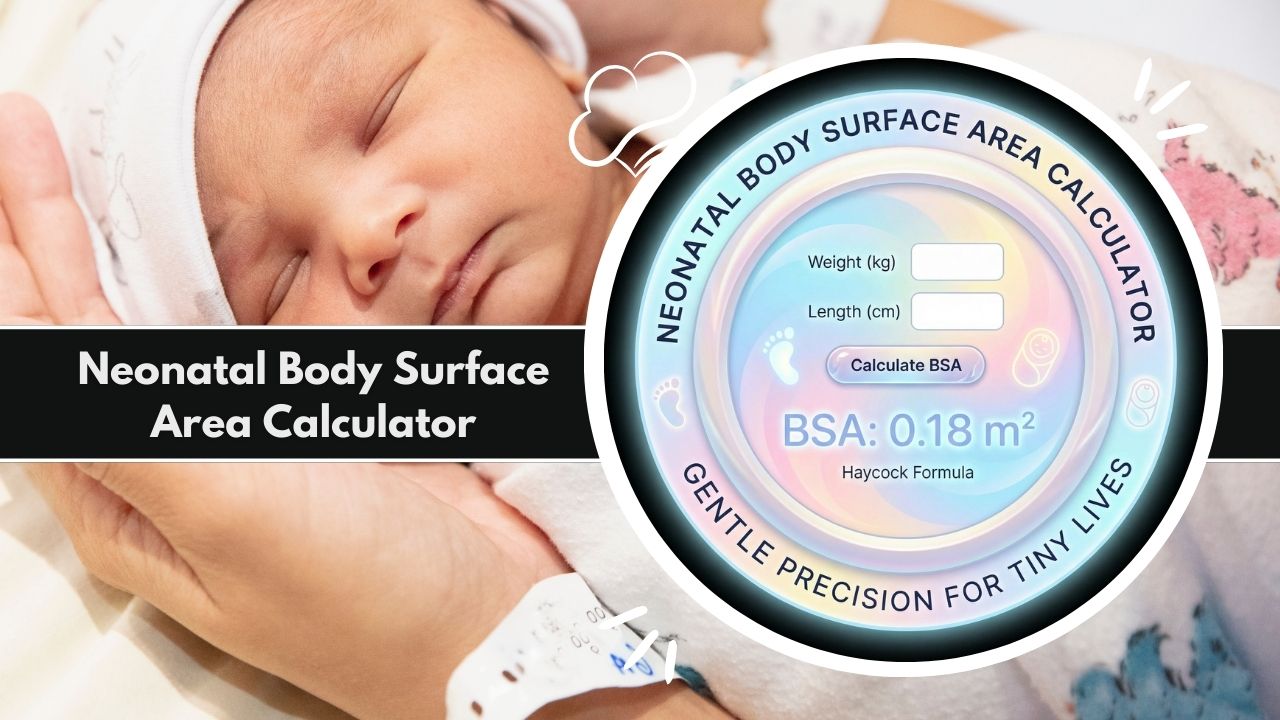
Use the Neonatal Body Surface Area Calculator for accurate NICU dosing. Calculate infant BSA using Haycock and Mosteller formulas. Essential for pediatric safety and critical care precision.
Introduction to the Neonatal Body Surface Area Calculator
In the high-stakes environment of neonatal intensive care, precision is not just a goal; it is a requirement for survival. The Neonatal Body Surface Area Calculator is a specialized digital utility designed to assist medical professionals, pediatricians, and pharmacists in determining the total surface area of a newborn’s body.
Unlike adult patients, where standard dosages often suffice, neonates require highly individualized treatment plans based on specific physiological metrics. Body Surface Area (BSA) is a critical parameter used to calculate dosages for chemotherapy agents, glucocorticoids, and fluids, making the Neonatal Body Surface Area Calculator an indispensable resource in modern pediatrics.
The physiology of a newborn differs vastly from that of an older child or adult. Neonates possess a disproportionately large surface area relative to their body weight. This unique anatomical characteristic influences metabolic rates, heat loss, and drug clearance.
Consequently, relying solely on weight-based calculations can sometimes lead to sub-therapeutic or toxic dosing. By utilizing a Neonatal Body Surface Area Calculator, clinicians can derive a metric that often correlates better with physiological maturity and glomerular filtration rate than weight alone.
This article explores the operational mechanics, clinical significance, and mathematical foundations of the Neonatal Body Surface Area Calculator. It delves into why specific formulas like Haycock are preferred for infants, how to accurately input data, and the vital role this tool plays in the Neonatal Intensive Care Unit (NICU).
Whether you are managing fluid therapy for a premature infant or calculating a narrow therapeutic index medication, understanding the utility of the Neonatal Body Surface Area Calculator is paramount for patient safety.
Why Neonatal BSA Matters in Clinical Practice
The clinical relevance of the Neonatal Body Surface Area Calculator extends beyond simple arithmetic. In neonatal care, the margin for error is virtually non-existent. A medication overdose that might cause mild side effects in an adult could be fatal for a 1,000-gram premature infant. BSA serves as a normalization factor. It allows clinicians to scale physiological parameters—such as cardiac output and renal function—across patients of vastly different sizes.
Furthermore, the Neonatal Body Surface Area Calculator is essential for managing insensible water loss. Neonates, especially those born extremely preterm, have thin, permeable skin and a high surface-area-to-weight ratio. This leads to significant fluid evaporation. By accurately calculating BSA, neonatologists can better estimate fluid replenishment needs, ensuring the infant maintains electrolyte balance and hemodynamic stability.
Who Uses Neonatal Body Surface Area Measurements
The Neonatal Body Surface Area Calculator is primarily utilized by healthcare providers specializing in infant care. This includes:
- Neonatologists: For prescribing complex drug regimens and managing parenteral nutrition.
- NICU Nurses: For verifying dosages and monitoring fluid balance charts.
- Pediatric Pharmacists: For double-checking medication orders against safe dosing protocols.
- Clinical Researchers: For standardizing data in clinical trials involving newborn subjects.
- Dietitians: For calculating energy expenditure and nutritional requirements based on metabolic surface area.
What the Neonatal Body Surface Area Calculator Is
The Neonatal Body Surface Area Calculator is a computational tool that processes anthropometric data—specifically weight and length—to estimate the external surface area of an infant’s body in square meters (m²). While the concept sounds simple, the mathematical derivation is complex due to the non-linear relationship between a baby’s height and mass.
Purpose of the Calculator in Newborn Healthcare
The primary purpose of the Neonatal Body Surface Area Calculator is to provide a standardized metric for dosing and physiological assessment. In the past, nomograms (graphical charts) were used, requiring clinicians to draw lines between height and weight columns to find the BSA. This manual method was prone to visual errors and variability.
The digital Neonatal Body Surface Area Calculator eliminates these manual inaccuracies, providing a consistent output to several decimal places, which is crucial when the total BSA might be as small as 0.15 m².
How the Calculator Simplifies Neonatal BSA Computation
Calculating BSA manually using complex exponents is time-consuming and prone to calculation errors in a busy clinical setting. For example, the Haycock formula requires raising weight and height to specific decimal powers.
A Neonatal Body Surface Area Calculator automates this process. The clinician simply enters the weight (typically in grams for precision) and length (in centimeters), and the tool instantaneously applies the mathematical logic to generate the result. This speed is vital during emergencies or rounds where rapid decision-making is required.
What the Neonatal Body Surface Area Calculator Does
The Neonatal Body Surface Area Calculator performs a series of mathematical operations based on validated medical formulas. It acts as a bridge between raw physical measurements and actionable clinical data.
Types of Neonatal Measurements It Accepts
To function correctly, the Neonatal Body Surface Area Calculator requires two specific inputs:
- Body Mass (Weight): In the neonatal context, this is usually measured in grams (g) or kilograms (kg). The tool typically converts grams to kilograms internally, as most formulas rely on kg.
- Body Length (Height): This is the measurement from the crown of the head to the heel of the foot, usually measured in centimeters (cm).
Unlike adult calculators that might accept inches or pounds, a professional Neonatal Body Surface Area Calculator prioritizes metric units, which are the standard in medical science and reduce the risk of conversion errors.
Accuracy and Output Details for Neonatal BSA
The output of the Neonatal Body Surface Area Calculator is a number expressed in square meters (m²). For a typical term neonate (3.5 kg, 50 cm), the BSA is approximately 0.24 m². For a micropreemie (700 g), the BSA might be as low as 0.09 m². The tool often provides results to three or four decimal places.
High-quality calculators also display results from multiple formulas (e.g., Haycock, DuBois, Mosteller) simultaneously, allowing the clinician to choose the method that aligns with their hospital’s protocol.
Key Features of the Neonatal Body Surface Area Calculator
A robust Neonatal Body Surface Area Calculator is designed with features that specifically address the nuances of newborn care.
Input Options for Neonate Weight and Length
Given that neonatal weights are recorded in grams, the best Neonatal Body Surface Area Calculator interfaces allow direct input in grams. This prevents the user from having to mentally divide by 1000 to get kilograms, removing a potential point of failure. Similarly, length inputs are validated to ensure they fall within physiological ranges for infants (e.g., 20 cm to 80 cm), alerting the user if a typo occurs.
Advanced Calculation Capabilities for Newborns
Advanced versions of the Neonatal Body Surface Area Calculator do not just output a single number. They may compute BSA using the Haycock formula—widely regarded as the gold standard for infants—while also providing the Mosteller value for comparison. This capability is essential because different departments (e.g., Oncology vs. Nephrology) might prefer different formulas. The calculator ensures that the clinician has all necessary data without needing multiple tools.
User-Friendly Interface for Fast Neonatal Assessment
In a NICU, lighting is often low, and stress levels are high. The interface of the Neonatal Body Surface Area Calculator is typically designed for high contrast and readability. Large input fields and clear, bold result displays ensure that the values are read correctly at a glance. The tool is also optimized for mobile devices, allowing practitioners to use it at the bedside during rounds.
Mathematical Formulas Used in the Neonatal Body Surface Area Calculator
The engine behind the Neonatal Body Surface Area Calculator relies on empirical formulas derived from studying the relationship between height, weight, and surface area.
Most Common Neonatal BSA Formulas (e.g., Haycock, Mosteller)
While there are many BSA formulas, only a few are validated for the unique body shape of neonates.
- Haycock Formula: This is often the preferred method in the Neonatal Body Surface Area Calculator. It was developed specifically to address the inaccuracies of adult formulas when applied to infants.
- Formula:
BSA (m²) = 0.024265 * Height(cm)^0.3964 * Weight(kg)^0.5378
- Formula:
- Mosteller Formula: Known for its simplicity, the Mosteller formula is widely used due to how easy it is to memorize. It involves a square root calculation.
- Formula:
BSA (m²) = sqrt( (Height(cm) * Weight(kg)) / 3600 )
- Formula:
- DuBois and DuBois: Historically the standard for adults, it is less commonly the primary choice for neonates but is often included in the Neonatal Body Surface Area Calculator for reference.
- Formula:
BSA (m²) = 0.007184 * Weight(kg)^0.425 * Height(cm)^0.725
- Formula:
Formula Variations for Premature and Full-Term Infants
The body proportions of a premature infant differ from those of a full-term baby. Premature infants have a larger head relative to their body and less subcutaneous fat. The Neonatal Body Surface Area Calculator is valuable because formulas like Haycock were validated across a wide range of sizes, including very small infants, ensuring that the non-linear geometry of a preemie’s body is accounted for better than in linear scaling methods.
Parameters Required for Neonatal BSA Calculations
To ensure the Neonatal Body Surface Area Calculator works correctly, precise parameters are needed. The weight must be the “dry weight” or the current daily weight, ensuring it reflects the actual mass without external equipment. Length measurements must be taken with a recumbent stadiometer (length board) rather than a tape measure over the curves of the body, as the formulas assume a straight-line height.
Variables and Physiological Considerations Explained
The variables in the Neonatal Body Surface Area Calculator (Height and Weight) serve as proxies for the two-dimensional surface of a three-dimensional object. The exponents in the formulas (like 0.5378 for weight in Haycock) adjust for the fact that as a body grows, mass increases cubically while surface area increases quadratically. In neonates, this curve is steeper, which is why the Neonatal Body Surface Area Calculator uses specific exponents different from adult geometry.
How to Use the Neonatal Body Surface Area Calculator Step-by-Step
Using the Neonatal Body Surface Area Calculator is straightforward, but adherence to a strict protocol ensures accuracy.
Required Inputs for Neonatal BSA Measurement
Before accessing the tool, gather the following data:
- Current Weight: Measured in grams. Ensure the scale was zeroed and the infant was unclothed.
- Current Length: Measured in centimeters using a length board. Two providers are often needed to straighten the infant’s legs gently for an accurate read.
Step-by-Step Usage Flow
- Open the Neonatal Body Surface Area Calculator.
- Select Units: Confirm the input fields are set to Grams (g) for weight and Centimeters (cm) for height.
- Enter Weight: Type the weight value (e.g., 1250).
- Enter Length: Type the length value (e.g., 38.5).
- Select Formula (Optional): If the calculator allows, select “Haycock” as it is preferred for neonates.
- Calculate: Press the button to process the data.
- Review: Read the result in m².
Tips for Accurate Neonatal BSA Results
- Double Check Inputs: A common error is entering kg instead of g (e.g., entering 1.2 instead of 1200). A good Neonatal Body Surface Area Calculator will flag extremely low values, but vigilance is required.
- Update Daily: In the NICU, weights change daily. Re-run the Neonatal Body Surface Area Calculator every time a new BSA-dependent medication dose is calculated.
- Consistency: Use the same formula (e.g., Haycock) throughout the patient’s stay to track trends consistently.
Neonatal Body Surface Area Calculator Example Calculation
To understand the output of the Neonatal Body Surface Area Calculator, let us look at a concrete example.
Sample Newborn Input Values
- Patient: Male, born at 34 weeks gestation.
- Weight: 2400 grams (2.4 kg).
- Length: 46 centimeters.
Step-by-Step Formula Computation
Using the Neonatal Body Surface Area Calculator with the Haycock formula:
- Convert grams to kg: 2400 g = 2.4 kg.
- Apply formula:
BSA = 0.024265 * (46)^0.3964 * (2.4)^0.5378 - Calculate height component:
46^0.3964 ≈ 4.56 - Calculate weight component:
2.4^0.5378 ≈ 1.60 - Multiply:
0.024265 * 4.56 * 1.60 - Result:
≈ 0.177 m²
Using the Mosteller formula for comparison:
- Multiply Height * Weight:
46 * 2.4 = 110.4 - Divide by 3600:
110.4 / 3600 = 0.03066 - Square Root:
sqrt(0.03066) - Result:
≈ 0.175 m²
Final Output Interpretation for Clinical Use
The Neonatal Body Surface Area Calculator would display a result of approximately 0.18 m². The clinician would then use this 0.18 m² value to calculate a dosage. For example, if a drug is dosed at 100 mg/m², the required dose would be 100 * 0.18 = 18 mg. Without the Neonatal Body Surface Area Calculator, determining this precise dosage would be prone to significant estimation errors.
Practical Applications of the Neonatal Body Surface Area Calculator
The utility of the Neonatal Body Surface Area Calculator spans several aspects of critical care.
Medication Dosing and NICU Treatment Planning
Chemotherapy agents and certain cardiac medications have a narrow therapeutic index. Dosing by weight alone can lead to toxicity in infants with fluid retention or edema. The Neonatal Body Surface Area Calculator provides a more stable metric that reflects metabolic mass, ensuring safe delivery of potent pharmacotherapeutics.
Fluid and Electrolyte Requirement Calculation
Fluid maintenance is often calculated based on BSA (e.g., 1500 mL/m²/day). This approach is particularly useful for infants with cardiac conditions where fluid overload is a risk. The Neonatal Body Surface Area Calculator helps clinicians define strict fluid restrictions or liberalizations based on the exact surface area.
Thermoregulation and Neonatal Care Assessment
An infant’s ability to maintain body temperature is directly linked to their surface area. A higher result on the Neonatal Body Surface Area Calculator relative to weight indicates a higher propensity for heat loss. Clinicians use this data to adjust incubator humidity and temperature settings to minimize thermal stress.
Growth Monitoring and Medical Research
Tracking BSA over time using the Neonatal Body Surface Area Calculator provides a composite view of growth. While weight and length are tracked individually, BSA growth velocity can be a useful marker in nutritional studies and long-term developmental tracking of Very Low Birth Weight (VLBW) infants.
Advantages of Using a Neonatal Body Surface Area Calculator
Digital tools have revolutionized NICU workflows.
Reduces Risk of Dosing Errors
The primary advantage of the Neonatal Body Surface Area Calculator is safety. By automating complex math, the risk of a decimal point error—a potential fatality in neonatology—is drastically reduced. The calculator ensures that the math is handled by a validated algorithm rather than a fatigued human brain.
Saves Time in Critical Neonatal Settings
In an emergency code situation or a busy admission, time is currency. A Neonatal Body Surface Area Calculator yields results in seconds. This efficiency allows the medical team to focus on the patient rather than the calculator, speeding up the “time to first dose” for critical antibiotics or fluids.
Ensures Consistent and Evidence-Based BSA Calculations
Standardization is key to quality improvement. When an entire unit uses the same Neonatal Body Surface Area Calculator, every provider is speaking the same language. This eliminates discrepancies that occur when one doctor uses a nomogram and another uses a different mathematical formula.
Common Mistakes When Using a Neonatal Body Surface Area Calculator
Despite the tool’s precision, user error remains a variable.
Incorrect Weight or Length Measurements
The Neonatal Body Surface Area Calculator is only as good as the data entered (“Garbage In, Garbage Out”). If a nurse estimates length using a tape measure on a wriggling baby, the result will be inaccurate. If the weight includes a wet diaper or heavy blanket, the calculated BSA will be artificially high, leading to potential overdosing.
Using Adult Formulas Instead of Neonatal Ones
Some generic calculators default to the DuBois formula, which was derived from a small sample size of adults in 1916. Using such a calculator for a 26-week preemie is inappropriate. It is vital to ensure the tool is specifically a Neonatal Body Surface Area Calculator that utilizes Haycock or similarly validated pediatric formulas.
Unit Conversion Mistakes (kg vs g, cm vs m)
A classic error involves units. Entering “1500” (grams) into a field expecting kilograms results in a massive calculation error. Conversely, entering “1.5” (kg) into a grams field results in a near-zero BSA. A well-designed Neonatal Body Surface Area Calculator clearly labels units to prevent this, but the user must remain vigilant.
Limitations of a Neonatal Body Surface Area Calculator
While powerful, the Neonatal Body Surface Area Calculator has limits.
BSA Accuracy Depends on Input Precision
The formulas are mathematical approximations. They assume a certain density and body geometry. If an infant has severe hydrocephalus (enlarged head) or limb anomalies, the standard Neonatal Body Surface Area Calculator may slightly under- or overestimate the true surface area because the body shape deviates from the norm used to create the formula.
Differences in Preterm vs Full-Term Neonate Physiology
Extremely premature infants have very different water content (80-90% total body water) compared to term infants. While the Neonatal Body Surface Area Calculator using the Haycock formula is the best tool available, clinical judgment is still required. The calculator provides a number; the clinician must interpret it within the context of the baby’s overall physiological state.
Accuracy Factors for Neonatal Body Surface Area Calculations
To maximize the benefit of the Neonatal Body Surface Area Calculator, attention to detail is required.
Measurement Tools and Method Consistency
Accuracy begins at the bedside. Using a calibrated digital scale and a fixed length board is non-negotiable. The Neonatal Body Surface Area Calculator relies on these tools being precise. Estimating length visually or using bed scales that haven’t been tared properly negates the precision of the digital calculation.
Neonate Movement and Handling Challenges
Newborns, even sick ones, move. Flexed posture (fetal position) makes length measurement difficult. Extending the legs for measurement can be stressful for the infant. Staff must balance the need for accurate data for the Neonatal Body Surface Area Calculator with the need to practice gentle handling and developmental care.
Formula Variability and Physiological Changes
A neonate’s weight can fluctuate by 10% or more in the first week of life due to diuresis. This means the output of the Neonatal Body Surface Area Calculator can change significantly day-to-day. It is not a “set it and forget it” metric; it must be recalculated frequently to remain accurate.
Industry Standards Related to Neonatal BSA Measurement
The use of the Neonatal Body Surface Area Calculator is governed by broader medical standards.
Pediatric Healthcare Guidelines
Organizations like the American Academy of Pediatrics (AAP) and the Pediatric Pharmacy Association (PPA) advocate for precise dosing methods. They recommend the use of electronic clinical decision support tools, such as the Neonatal Body Surface Area Calculator, to reduce medication errors.
NICU and Neonatal Pharmacology Standards
Pharmacopeias and hospital formularies specify which drugs require BSA dosing. For these medications, the use of a validated Neonatal Body Surface Area Calculator is often a mandatory step in the medication verification protocol within the electronic health record (EHR) system.
Troubleshooting Issues in Neonatal BSA Calculations
When the Neonatal Body Surface Area Calculator produces a confusing result, troubleshooting is necessary.
Unexpected BSA Outputs
If the BSA seems too high or too low (e.g., > 0.5 m² for a newborn), check the inputs. Did you enter weight in pounds instead of grams? Did you enter length in inches? Re-entering the data into the Neonatal Body Surface Area Calculator usually resolves these outliers.
Missing or Incorrect Neonatal Data
Sometimes length is not recorded daily. Using a length measurement from a week ago with today’s weight can skew the Neonatal Body Surface Area Calculator results, as infants grow in length rapidly. Always ensure both variables are current.
Unit Mismatch and Conversion Errors
If the calculator output is NaN (Not a Number) or incredibly large, a unit mismatch is the likely culprit. Ensure that the Neonatal Body Surface Area Calculator settings match the measurements taken at the bedside.
Frequently Asked Questions About the Neonatal Body Surface Area Calculator
What is the best formula for a Neonatal Body Surface Area Calculator?
The Haycock formula is generally considered the most accurate for the Neonatal Body Surface Area Calculator because it was validated using infants and covers a wide range of body surface area to weight ratios.
Can I use the DuBois formula in a Neonatal Body Surface Area Calculator?
You can, but it is less ideal. The DuBois formula was originally derived from adults. While it is often included in the Neonatal Body Surface Area Calculator for comparison, Haycock or Mosteller are preferred for pediatric accuracy.
Why does the Neonatal Body Surface Area Calculator require height?
BSA is a 2D measurement of the skin’s surface. Weight alone is a measure of mass volume. Height provides the second dimension necessary for the Neonatal Body Surface Area Calculator to estimate the total area covering that mass.
How often should I use the Neonatal Body Surface Area Calculator?
You should use the Neonatal Body Surface Area Calculator whenever a new order for a BSA-dependent medication is written or at least weekly to adjust for the rapid growth of the infant.
Is the Neonatal Body Surface Area Calculator different from BMI?
Yes. BMI (Body Mass Index) measures body fat/mass ratio, whereas the Neonatal Body Surface Area Calculator estimates the total skin surface area. They are distinct metrics with different clinical uses.
Does the Neonatal Body Surface Area Calculator work for premature babies?
Yes, specifically if it uses the Haycock formula. The Neonatal Body Surface Area Calculator is an essential tool for calculating fluids and drugs for premature infants in the NICU.
What is the average BSA for a term newborn?
Using a Neonatal Body Surface Area Calculator, a typical 3.5 kg, 50 cm newborn has a BSA of approximately 0.23 to 0.25 m².
Why is BSA dosing safer than weight-based dosing?
For certain toxic drugs, BSA correlates better with metabolic rate and clearance. The Neonatal Body Surface Area Calculator helps tailor the dose to the baby’s physiological capacity to process the drug, reducing toxicity risks.
Can I use an adult calculator for a neonate?
It is risky. Adult calculators may not allow low weights (like 500g) or may use formulas not validated for small bodies. Always use a dedicated Neonatal Body Surface Area Calculator.
How accurate is the Mosteller formula in a Neonatal Body Surface Area Calculator?
Mosteller is quite accurate and very popular due to its simplicity. Results from the Mosteller method in a Neonatal Body Surface Area Calculator are usually very close to the Haycock method.
What units does the Neonatal Body Surface Area Calculator use?
Standard output is in square meters (m²). Inputs are typically grams or kilograms for weight and centimeters for length.
Is the Neonatal Body Surface Area Calculator useful for fluid management?
Absolutely. Insensible water loss is proportional to surface area. The Neonatal Body Surface Area Calculator allows neonatologists to calculate exact fluid requirements to prevent dehydration.
What if the baby has edema?
Edema increases weight without increasing true tissue mass. This can skew the Neonatal Body Surface Area Calculator results. Clinicians often use “dry weight” or an estimated baseline weight in these cases.
Related Tools & Calculators:
- Body Surface Area Calculator Dubois
- Burn Surface Area Calculator
- Body Surface Area Calculator Cat
- Body Surface Area Calculator Dog
- Body Surface Area Calculator Child
- Body Surface Area Calculator
- Aortic Valve Area Calculator
- Running Distance Calculator
- Running Pace Calculator
- Medicine Time Zone Calculator
- Birth Control Time Zone Calculator