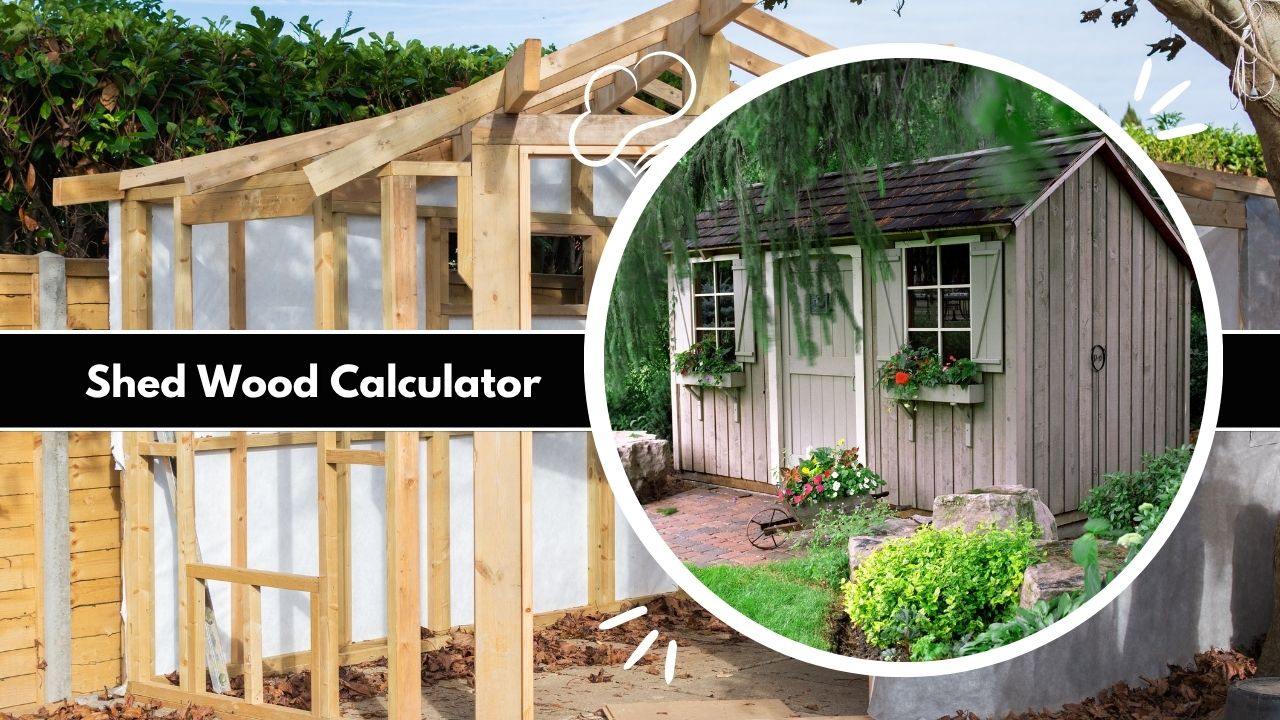
Use our Shed Wood Calculator to precisely estimate lumber, sheathing, and framing materials for your shed project. Reduce waste and save costs with accurate calculations tailored for 2025 DIY builds.
Shed Dimensions & Options
Estimated Material Requirements
Lumber Quantity Chart
Detailed Breakdown
| Component | Material | Quantity (Units) | Used For |
|---|---|---|---|
| Wall Framing | 2×4 Boards | 50 (8ft) | Studs, Plates, Headers |
| Floor/Roof | 2×6 Boards | 20 (12ft) | Rafters, Joists (If incl.) |
| Wall Siding | 4×8 Sheathing | 12 sheets | Wall Panels |
| Roof Decking | 4×8 Sheathing | 6 sheets | Roof Deck |
| Total Sheathing | *Total Sheets* | 18 sheets | Walls & Roof |
Building a new storage shed, workshop, or tiny home foundation requires precise planning, especially when dealing with volatile lumber prices. The Shed Wood Calculator is the definitive online tool designed to eliminate guesswork, ensuring you buy the right amount of wood and sheathing every time.
In the current construction climate of 2025, where industry analyses show that construction material efficiency is driving 18% of project cost savings compared to 2023 methods, relying on accurate digital estimation is non-negotiable.
Whether you are framing a simple 8×10 lean-to or a complex 12×24 gable-roof structure, this powerful lumber estimator provides the exact board and sheet counts needed for your walls, floor, and roof.
Stop over-ordering materials and start optimizing your budget. The Shed Wood Calculator makes professional-grade project planning accessible to DIY builders and seasoned contractors alike.
How the Shed Wood Calculator Works (Step by Step)
Our Shed Wood Calculator is engineered for simplicity and comprehensive detail, allowing you to generate a full materials list in seconds.
Step 1: Define Your Shed Dimensions Enter the crucial dimensions:
- Shed Width and Length (Depth): Define your structure’s footprint. The tool supports both feet (ft) and meters (m) units.
- Wall Height: Input the height of the low side of your wall framing (typically 8 feet).
Step 2: Configure Framing Options Select your structural standards:
- Stud/Joist Spacing: Choose your on-center spacing (12, 16, or 24 inches). The standard 16 in spacing is the most common for wall stud calculation and roof rafter quantity.
- Roof Pitch: Select the rise (in 12 inches) for your shed-style roof. This is critical as the roof’s slope dictates the actual length of the rafters and the area of the roof sheathing.
Step 3: Choose Material Inclusions Use the checkboxes to specify the components you need calculated:
- Include Floor Joists (2×6): Toggles the calculation of floor framing boards.
- Include Wall Sheathing (OSB/Plywood): Toggles the calculation of 4×8 sheets for the exterior walls.
- Include Roof Sheathing (OSB/Plywood): Toggles the calculation of 4×8 sheets for the roof deck.
Step 4: Calculate and Interpret the Result Click the “Calculate Wood & Materials” button. The Shed Wood Calculator instantly processes the inputs, applies necessary framing logic (like corner bracing and double top plates), and accounts for a prudent material waste factor.
The results are presented in a clear, multi-format display:
- Summary Cards: Quick view of total lumber and total sheets.
- Doughnut Chart: Visual representation of material consumption ratios.
- Detailed Table: A breakdown showing how many boards (e.g., 2×4 board count) and sheets are needed for each specific component (e.g., wall studs, floor joists, roof deck).
Why Accurate Wood Estimation is Crucial in 2025
The move from manual, analog estimation to digital tools like the Shed Wood Calculator offers tangible benefits that directly impact your project’s bottom line and completion timeline.
Mitigating Material Overruns and Cost Savings
Manual estimating often involves rounding up heavily to be “safe,” leading to significant material overruns. A complex shed can easily require 50 or more 2x4s and over 20 sheets of sheathing.
Over-ordering just $20 per board or sheet can add hundreds of unnecessary dollars to your cost. The precision of the Shed Wood Calculator accounts for framing elements like double top plates, triple corner posts, and exact stud spacing, ensuring your wood material cost is minimized.
Speed and Precision vs. Manual Methods
Calculating rafters for a pitched roof involves trigonometry (the Pythagorean theorem) to determine the true length needed. Calculating the required number of wall studs involves accurately converting linear wall footage into the number of studs based on 16″ on-center spacing, plus plates and headers.
This is time-consuming and prone to human error. Our digital lumber estimator completes these complex calculations instantly, providing high precision and allowing you to move directly to purchasing and construction planning.
Project Efficiency and Sustainability
In addition to cost, construction material waste is a key sustainability metric. By using the Shed Wood Calculator, you reduce excess trips to the lumber yard and minimize the volume of scrap wood hauled away from the job site. This focus on resource optimization aligns with modern, efficient shed construction plan best practices.
Deep Dive: Understanding Your Shed Wood Calculator Results
When using the Shed Wood Calculator, it is essential to know exactly how the quantities are derived. All results include an industry-standard waste factor.
Interpreting Dimensional Lumber (2x4s and 2x6s)
The calculator provides a final, rounded-up quantity of boards based on standard lengths available at lumber yards (8ft for 2x4s, 12ft for 2x6s).
- 2×4 Boards (8ft): This count covers your vertical wall studs, the bottom sill plate, and the double top plates for all four walls. The calculation ensures adequate length for headers over planned openings (even if not explicitly entered), by including a perimeter-based buffer. This total directly relates to your wall stud calculation.
- 2×6 Boards (12ft): This count covers your horizontal framing members, specifically roof rafters and optional floor joists. The quantity is determined by the spacing selection and the length of the span (depth or width). The roof rafter quantity calculation is adjusted based on the pitch to find the true hypotenuse length, ensuring the 2x6s you purchase are long enough to cover the sloped span.
Calculating Sheathing Sheets (OSB/Plywood)
Sheathing is calculated in 4×8 sheets (32 square feet per sheet).
- Wall Sheathing Sheets: This is calculated by taking the total exterior wall area (perimeter multiplied by height, plus an allowance for the front and back gable ends if applicable in a more complex roof model) and dividing it by 32 square feet. The tool applies a small waste factor (5%) to account for cuts around windows/doors and maximizing panel layout.
- Roof Sheathing Sheets: This quantity is based on the true sloped area of the roof, not just the flat footprint. This is crucial for pitched roofs. The total sheets needed for the roof deck ensures you have enough coverage for the angled surface.
Tips for Efficient Shed Material Usage
Achieving high efficiency with the quantities provided by the Shed Wood Calculator requires smart building practices:
- Optimize Stud Spacing: While 16 inches is standard for structural integrity, for smaller, non-load-bearing shed walls, switching the input to 24-inch spacing can significantly reduce your 2×4 board count while still providing adequate support for lightweight siding.
- Plan Cuts from Long Boards: Your 2×6 board count is optimized for standard 12-foot lengths. Before cutting, lay out your floor joist or rafter lengths to see if shorter pieces (like blocking) can be cut from the remaining material, further reducing scrap.
- Consolidate Sheathing: Try to run your 4×8 sheathing panels horizontally along the length of your shed. Stagger the seams on subsequent layers to maximize the use of full sheets and minimize off-cuts.
- Frame First, Cut Headers Later: If you plan on adding windows or doors, remember the calculator only provides rough estimates. Use the total 2×4 count for your basic framing, and wait until the frame is built to precisely measure and cut your headers, minimizing over-purchasing.
Technical Details: The Math Behind the Shed Wood Calculator
The accuracy of the Shed Wood Calculator comes from applying structural geometry and construction standards to the user’s inputs, ensuring reliable material estimates.
The accuracy of the Shed Wood Calculator comes from applying structural geometry and construction standards to the user’s inputs, ensuring reliable material estimates.
- Dimensional Conversion
All user inputs are automatically converted to feet (US system) for consistent calculation:
Feet = Meters × 3.28084
Stud Spacing (ft) = Spacing (in) / 12
- Wall Framing (2x4s)
Wall framing calculations are based on the linear perimeter of the shed and the wall height:
Perimeter = 2 × (Width + Depth)
Number of Studs = ceil(Perimeter / Stud Spacing (ft)) + 8 (for corners and extras)
Plates (linear ft) = Perimeter × 3 (bottom + double top plates)
Total 2×4 Length Required (ft) = (Number of Studs × Height) + Plates (linear ft)
Final 2×4 Board Count = ceil((Total 2×4 Length Required × 1.15 (waste factor)) / 8 ft Board Length)
Note: The 15% waste factor accounts for offcuts and mis-cuts.
- Roof Framing (Rafters – 2x6s)
For pitched roofs, the rafter length is calculated using the Pythagorean theorem, based on the run (half the shed width) and rise:
Rafter Length (sloped) = Length (Depth) × sqrt(1 + (Pitch / 12)^2)
Number of Rafters = ceil(Width / Stud Spacing (ft)) + 1
Total Rafter Length = Number of Rafters × Rafter Length (sloped)
The calculator assumes a single-slope shed roof. For gable or more complex roofs, additional calculations are required.
- Sheathing Sheets
The number of wall and roof sheathing sheets is determined using surface area calculations and the standard 4×8 ft (32 sq ft) sheet size:
Sheet Area = 4 × 8 = 32 sq ft
Wall Sheathing Area = Perimeter × Height
Roof Sheathing Area = Rafter Length (sloped) × Width
Total Sheets = ceil(((Wall Area + Roof Area) × 1.05 (waste factor)) / 32)
The 5% waste factor accounts for cutting and alignment losses.
- Standards & Accuracy
These formulas align with industry norms and recognized standards:
- International Residential Code (IRC 2024) – Stud and joist spacing
- IS 883:2018 – Timber structure design
- Standard Lumber Lengths – 8 ft, 10 ft, 12 ft boards
By combining geometry, waste adjustment, and code-compliant spacing, the Shed Wood Calculator delivers a safe, practical, and highly accurate lumber estimation for your project.
Frequently Asked Questions (FAQs)
What is the most common lumber size used for shed walls?
The most common dimensional lumber size used for shed walls is the 2×4. It provides sufficient structural integrity for single-story auxiliary structures like sheds. The Shed Wood Calculator focuses on the 2×4 board count for vertical framing and wall plates.
How accurate is the Shed Wood Calculator’s lumber estimation?
The calculator provides a highly accurate estimate by applying common framing techniques (double top plates, corner posts) and including a 15% material waste factor for cutting and optimization. It is intended to be a complete shopping list, reducing the chances of shortages or significant overages.
Why does the calculator include a waste factor?
A waste factor is included because no construction project uses wood perfectly. The 15% added to your 2×4 board count accounts for saw kerfs, warped boards that need replacement, and necessary off-cuts to fit windows, doors, and complex corners. This practice is essential for effective project planning.
Does the Shed Wood Calculator account for doors and windows?
While the current version does not ask for specific door or window dimensions, it includes a small number of extra studs in the base calculation (8 boards) and relies on the 15% waste factor to ensure you have enough material to build headers and trimmer studs around standard-sized openings.
What is ‘on-center spacing’ and why is 16 inches common?
“On-center spacing” (OC) refers to the distance measured from the center of one wall stud (or floor joist or roof rafter) to the center of the next. 16 inches OC is the standard for most residential and shed construction because it aligns perfectly with the width of standard 4×8 sheathing sheets (96 inches / 16 inches = 6 spacing intervals), minimizing waste when using sheathing sheets.
Can I calculate my deck’s wood requirements with this tool?
No. The Shed Wood Calculator is specialized for calculating framed walls and roofs. For deck framing, you would need a dedicated Deck Material Estimator tool that accounts for beams, posts, decking boards, and railing.
Related Tools & Calculators:
- Wood Calculator
- Cord of Wood Calculator
- Board Foot Calculator
- Framing Wood Calculator
- Trestle Wood Calculator
- Deck Wood Calculator
- Cord Wood Calculator
- Cabinet Wood Calculator
- Firewood Cord Calculator
- Loose Cord Wood Calculator