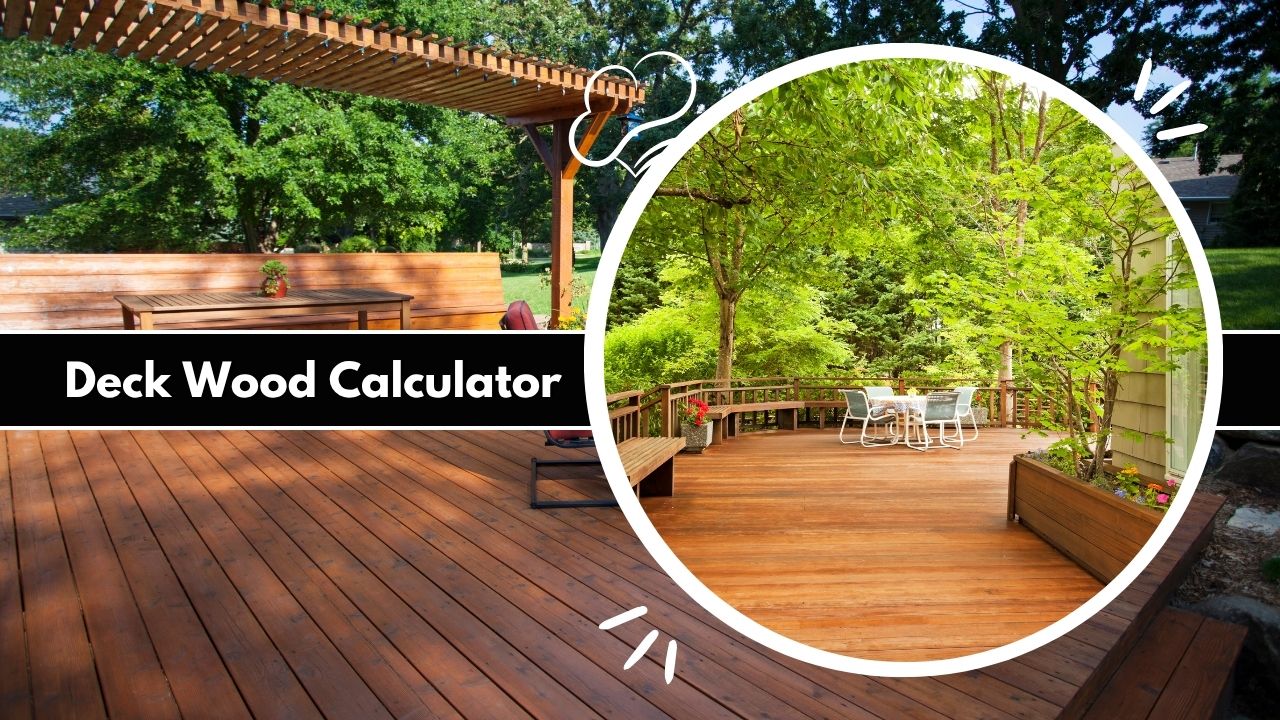
Discover the Deck Wood Calculator, your essential tool for accurate deck material estimation in 2025. Calculate wood decking, joists, beams, and more to minimize waste, save costs, and streamline your outdoor construction project efficiently.
Deck Specifications
Material Costs
Project Summary
Material & Cost Breakdown
| Item | Quantity | Estimated Cost |
|---|
Planning a deck construction project requires precise material calculations to avoid costly overruns or frustrating shortages. Our Deck Wood Calculator is an essential digital tool that helps homeowners and contractors accurately estimate the lumber, fasteners, and foundation materials needed for any deck building project.
With construction material costs increasing by 8.3% in 2024 according to the National Association of Home Builders, proper planning has never been more critical for budget-conscious projects. This advanced material estimator takes the guesswork out of deck planning by providing detailed quantity calculations and cost projections based on your specific dimensions and local material prices.
Whether you’re building a simple ground-level platform or an elaborate multi-level outdoor living space, our Deck Wood Calculator ensures you purchase the right amount of decking boards, joists, beams, and posts while minimizing expensive waste.
How Deck Wood Calculator Works (Step by Step)
Using the Deck Wood Calculator is straightforward, making it accessible for both novices and experienced builders. Here’s a step-by-step guide to get accurate results for your deck construction project:
- Enter Deck Specifications: Start by inputting the deck length and width in feet. Select the decking board size (e.g., 1×6 or 5/4×6 at 5.5 inches, or 1×4 at 3.5 inches) and joist spacing (on center, options include 12, 16, or 24 inches). These inputs form the basis for calculating the deck’s area and structural needs.
- Provide Material Costs: Fill in the costs per unit for key items, such as decking boards, joists (2x8x12′), beams (2x10x16′), posts (4x4x8′), concrete bags (80lb), and fastener boxes. Default values are pre-filled, but customize them based on 2025 market prices for precise budgeting.
- Calculate and Review Results: Click the “Calculate Materials” button. The tool validates inputs to ensure positive numbers, then computes quantities using built-in formulas. For instance, it calculates the number of decking boards by considering board width, a 0.125-inch gap, and a 10% waste factor for cuts and imperfections. Joists are determined by deck length divided by spacing, plus one for support. The output includes a categorized table (Decking, Framing, Foundation, Hardware), total cost, cost per square foot, and a doughnut chart for cost distribution.
- Interpret and Export: Review the summary for overall insights, then export as PDF or CSV for sharing with suppliers or contractors. This step ensures your deck wood calculation is actionable, helping you purchase exactly what’s needed without overbuying.
The Deck Wood Calculator interprets results by grouping materials logically, highlighting potential savings through efficient estimation.
Why Use This Tool
Accuracy and Precision
Manual deck material calculations often lead to significant errors. Our Deck Wood Calculator applies industry-standard formulas and accounts for realistic waste factors (typically 10%), ensuring you purchase exactly what you need without excessive surplus.
Time and Cost Efficiency
According to construction industry data, proper material planning can reduce project costs by 15-20% by minimizing waste and preventing last-minute purchases at premium prices. The Deck Wood Calculator accomplishes in minutes what might take hours of manual calculation.
Project Confidence
Eliminate the stress of uncertainty with precise material lists and budget projections. Contractors can provide more accurate quotes, while DIY enthusiasts can approach their projects with greater assurance.
Adaptability
The tool accommodates various deck designs, material types, and regional pricing differences, making it suitable for projects across different climates and building jurisdictions.
Understanding Your Deck Wood Calculator Results
When you receive your calculation report from the Deck Wood Calculator, you’ll see several key components that help inform your purchasing decisions. The total cost summary provides immediate budget context, while the cost per square foot metric allows for easy comparison with industry benchmarks.
The material breakdown organizes components by category: decking, framing, foundation, and hardware. This logical grouping mirrors how you’ll actually purchase materials at lumber yards and building supply centers. Each item includes both quantity and extended cost, giving you complete visibility into where your budget is allocated.
Tips for Efficient Material Usage in Deck Construction
Optimize Board Layout: Before purchasing, consider how your decking board lengths will minimize waste. The Deck Wood Calculator assumes standard 16-foot boards, but if your deck length is 12 feet, you might request custom cuts or adjust your material list accordingly.
Strategic Joist Planning: While 16-inch joist spacing is standard, certain composite decking materials may allow 24-inch spacing, potentially reducing your lumber requirements by up to 30%. Always consult manufacturer specifications before altering standard framing practices.
Bundle Purchases: When using your Deck Wood Calculator results for purchasing, ask about volume discounts for buying full bundles of decking or complete units of dimensional lumber. Many suppliers offer better pricing when you purchase in larger quantities.
How to Optimize Concrete and Foundation Materials Naturally
Proper Footing Calculations: The Deck Wood Calculator determines concrete needs based on standard sonotube footings. For most residential decks, 8-inch diameter footings extending below the frost line provide adequate support. In warmer climates with minimal frost penetration, shallower footings may be acceptable, potentially reducing your concrete requirements.
Post Spacing Efficiency: The calculator assumes posts every 8 feet along beams, which provides robust support for most applications. If using higher-strength lumber or building in areas without heavy snow loads, you might extend this to 10 feet with proper engineering approval, reducing post and concrete quantities.
Material Substitutions: Consider alternative foundation systems like helical piles or deck blocks for low-level decks, which can eliminate concrete entirely. The Deck Wood Calculator focuses on traditional methods but remains valuable for cost comparison between different approaches.
Advanced Deck Planning Strategies for 2025
The deck building industry continues evolving with new materials and techniques. Modern composite decking often has different installation requirements than traditional wood, potentially affecting your material calculations. The Deck Wood Calculator accommodates these variations through adjustable board dimensions and fastening requirements.
Sustainability continues gaining importance in outdoor construction. The calculator helps minimize environmental impact by reducing material waste—a significant concern as 12.5% of construction lumber typically ends up as jobsite waste according to 2024 industry data.
Integrating Deck Calculations with Overall Project Planning
While the Deck Wood Calculator provides precise material quantities, successful projects also require considering labor, equipment, and timeline factors. Use your calculated material list to coordinate delivery schedules that align with your construction phases, preventing weather damage to stored materials and maintaining an organized worksite.
For complex projects involving multiple levels, built-in seating, or elaborate railings, consider using the calculator for each distinct section separately, then combining results for a comprehensive material list.
Technical Details
The Deck Wood Calculator employs standard formulas derived from construction engineering principles. For decking boards: Number of rows = ceil(deck width / effective board width), where effective width = (board width + 0.125″ gap) / 12; total boards = ceil((rows * length / 16) * 1.10 waste factor).
Joists: Number = floor(length * 12 / spacing) + 1. Beams: ceil(length / 16) * 2. Posts: (floor(length / 8) + 1) * 2. Concrete: Footing volume = π * (6″^2) * 36″ / 1728; bags = ceil(volume / 0.6 * posts). Fasteners: ceil(rows * joists * 2 / 250).
These align with standards like the International Residential Code (IRC) 2024 updates for 2025, ACI 318 for concrete elements, and AWC’s Prescriptive Residential Wood Deck Construction Guide. Data sources include Civil Engineering Journals and NRMCA guidelines for material densities.
FAQs: Deck Wood Calculator
What measurements do I need for the Deck Wood Calculator?
You’ll need your deck’s length and width in feet, plus your local material costs for accurate budgeting.
How accurate is the Deck Wood Calculator for complex deck designs?
The calculator provides excellent accuracy for standard rectangular decks. For multi-level or irregular shapes, calculate each section separately and combine results.
Can the Deck Wood Calculator account for different decking materials?
Yes, the tool accommodates various board dimensions and allows custom pricing for any material type from traditional wood to modern composites.
Does the calculator include building code requirements?
While it follows standard practices, always verify local building codes as requirements can vary by municipality.
How does the Deck Wood Calculator handle waste factors?
The tool includes a 10% waste factor for cutting and defects, which is standard for deck construction projects.
Can I save my calculations for future reference?
Yes, use the export features to download PDF or CSV files containing your complete material list and cost breakdown.
Does the calculator include railings and stairs?
The current version focuses on the deck structure itself. Separate calculations are needed for railings, stairs, and accessories.
How often should I update material costs in the calculator?
Update prices monthly, as lumber and construction material costs can fluctuate significantly throughout the year.
How many deck boards do I need for a 12×16 deck?
For a 12×16 foot deck using standard 1×6 (which are actually 5.5″ wide) decking boards, you would need approximately 35 boards that are 16 feet long. Our Deck Wood Calculator can give you an exact number based on your specific inputs.
Is it cheaper to build a wood deck myself?
Yes, typically. Labor can account for more than half the cost of a professionally installed deck. By using our calculator to plan your materials and performing the labor yourself, you can save thousands of dollars.
What is the best wood for a deck?
Pressure-treated (PT) pine is the most common and affordable option. Cedar and Redwood are naturally rot-resistant and offer a more premium look but come at a higher cost. Composite decking is a durable, low-maintenance alternative that has a high upfront cost but saves money on upkeep over time.
How much of a gap should be left between deck boards?
The standard gap is 1/8 inch. This allows for proper water drainage and gives the wood boards room to expand and contract with changes in temperature and humidity, preventing buckling.
Related Tools & Calculators:
- Trestle Wood Calculator
- Framing Wood Calculator
- Board Foot Calculator
- Wood Calculator
- Cord of Wood Calculator
- Material Calculator